QV/06.01Guide
The medical menu
The one window everything medical happens in: the tabs, the body colours, what a wound name means, and why a casualty is out.
QV/06.01/G1GuideThe menu
Open it on a casualty (or yourself) from the ACE interaction menu, Medical, Open medical menu. Everything medical in the game happens in this one window.
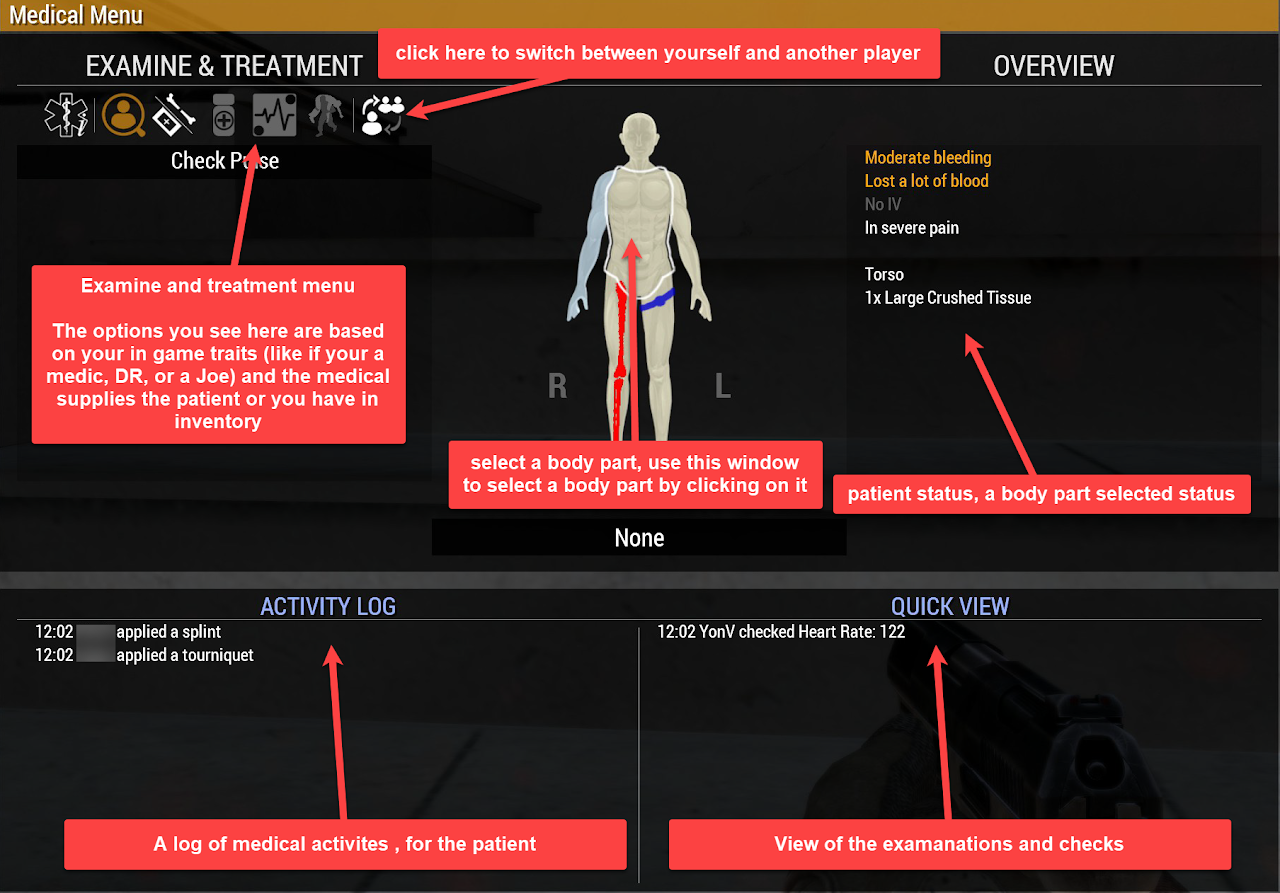
- Examine and treatment, top left: what you can do to the selected body part. The options you see depend on your skill (soldier, CLS, Medic) and on what is in your inventory and the casualty's.
- The body, middle: click a body part to select it. The selected part is outlined.
- Overview, top right: the casualty's state, then the selected body part's wounds.
- Activity log, bottom left: what has been done to this casualty, by whom and when.
- Quick view, bottom right: the results of the checks you have made (pulse, blood pressure, breathing).
QV/06.01/G2GuideThe seven tabs
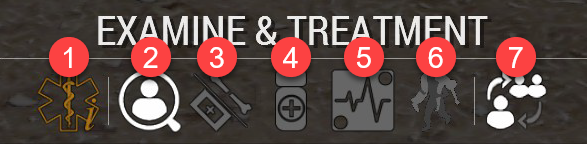
- Triage card: the history of treatment, and the casualty's triage status.
- Diagnose: pulse, blood pressure, responsiveness, breathing, inspect chest.
- Bandages and fractures: bandages, wraps, tourniquets, splints.
- Medication: autoinjectors, inhalers, pills, and for the Medic the drawn-up drugs.
- Advanced treatment: the Medic's airway, chest and IV work. CPR is in here too, and anyone can do CPR.
- Drag and carry.
- Toggle self: switch the menu between you and the casualty.
QV/06.01/G3GuideReading the body
The body colours tell you where to go first.
| Colour | Meaning |
|---|---|
| Red | Open wounds, severe bleeding |
| Orange | Open wounds, moderate bleeding |
| Yellow | Open wounds, minor bleeding |
| Light blue | Bruised |
| Dark blue | Fully bandaged |
| Blue band | Tourniquet on that limb |
| Red bone | Fractured |
| Blue bone | Splinted |
QV/06.01/G4GuideReading a wound
The overview names every wound on the selected body part, with its size and type. The type tells you how much it hurts and how fast it bleeds.
| Wound | Caused by | Pain | Bleeding |
|---|---|---|---|
| Avulsion | Explosions, shrapnel; a piece of the body torn away | Extreme | Extremely fast |
| Velocity wound | Bullets and shrapnel | Extreme | Medium |
| Laceration | Large force on the body; ragged edges | Slight | Slow |
| Cut | Sharp edges | Slight | Slow |
| Puncture | A narrow sharp object | Slight | Slow |
| Crush | Blunt force, vehicle crashes, falls | Moderate | Slow |
| Abrasion | Friction, rope burn, vehicle crashes | Low | Extremely slow |
| Contusion | Blunt force without breaking the skin; a bruise | Low | None, but internal |
When a body part has several wounds, treat them in this order: avulsion, velocity, laceration, cut, puncture, crush, abrasion, contusion. The bleeding is what kills; the bruise can wait.
QV/06.01/G5GuideWhy a casualty is out
A casualty goes unconscious when any one of these is true, and cannot wake up until it is fixed.
- Pain past the threshold.
- Blood pressure too low.
- Cardiac arrest.
- Oxygen saturation under 90.
While unconscious the game checks the vitals every 15 seconds; a casualty with stable vitals and none of the four can be woken with an ammonia inhalant, or wakes on their own.
- A tourniquet left on hurts. Left on long enough it puts the casualty out on pain alone. Take it off once the wounds under it are bandaged.
- Death is delayed in our settings. The unit's aim is to treat and recover every casualty on the battlefield, not to respawn.
- AI go unconscious the same way and can be revived the same way.